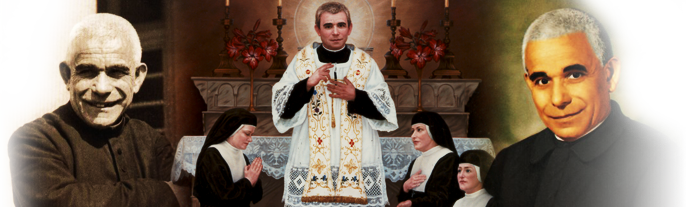
Luis Orione was born in Pontecurone, diocese of Tortona, on June 23, 1872. At the age of 13, he was accepted into the Franciscan convent of Voghera (Pavia) which he left after a year for health reasons. From 1886 to 1889, he was a student of John Bosco at the Valdocco Oratory in Turin. On October 16, 1889, he entered the seminary in Tortona. Still a young cleric, he dedicated himself to living in solidarity with his neighbor in the St. Marcellian Mutual Aid Society and the St. Vincent de Paul Society. On July 3, 1892, he opened the first Oratory in Tortona to take care of the Christian education of the youth. The following year, on October 15, 1893, Luis Orione, a 21-year-old cleric, opened a school for poor boys in the San Bernardino district. On April 13, 1895, Luis Orione was ordained a priest and, at the same time, the Bishop vested six students from his school with the clerical habit. In a short time, Don Orione opened new houses in Mornico Losana (Pavia), in Noto (Sicily), in Sanremo, and in Rome. Around the young Founder, clerics and priests grew, forming the first core of the Little Work of Divine Providence. In 1899, he initiated the branch of the Hermits of Divine Providence. The Bishop of Tortona, Mons. Igino Bandi, with a Decree of March 21, 1903, canonically recognized the Sons of Divine Providence (priests, coadjutor brothers, and hermits), a male religious congregation of the Little Work of Divine Providence, dedicated to “collaborating to bring the little ones, the poor, and the people to the Church and the Pope, through works of charity,” professing a fourth vow of special “fidelity to the Pope”. In the first Constitutions of 1904, among the purposes of the new Congregation appears the work “to achieve the union of the separated Churches”. Driven by a great passion for the church and the salvation of souls, he actively engaged with the emerging issues of that time, such as the freedom and unity of the Church, the “Roman question”, modernism, socialism, and the Christianization of the working masses. He heroically assisted populations affected by the earthquakes in Reggio and Messina (1908) and the Marsica (1915). By the wish of Pius X, he was Vicar General of the diocese of Messina for three years. Twenty years after the foundation of the Sons of Divine Providence, as in “a single plant with many branches”, on June 29, 1915, he started the Congregation of the Little Missionary Sisters of Charity, animated by the same foundational charism, and in 1927, the Blind Sacramentine Adorers Sisters were added, later joined by the Contemplatives of the Crucified Jesus. He organized laypeople in the associations of the “Ladies of Divine Providence”, the “Ex-Students”, and the “Friends”. Later, the Secular Orionine Institute and the Orionine Lay Movement would take shape. After the First World War (1914-1918), schools, colleges, agricultural colonies, charitable and welfare works multiplied. Among the most characteristic works, he created the “Little Cottolengos” for the suffering and abandoned, emerging on the outskirts of large cities as “new pulpits” from which to speak of Christ and the Church, “beacons of faith and humanity”. Don Orione’s missionary zeal, already manifested with the sending of his first religious to Brazil in 1913, later extended to Argentina and Uruguay (1921), England (1935), and Albania (1936). In 1921-1922 and 1934-1937, he himself made two trips to Latin America, Argentina, Brazil, and Uruguay, reaching as far as Chile. He enjoyed the personal esteem of the Popes and the authorities of the Holy See, who entrusted him with numerous and delicate tasks to solve problems and heal wounds both within the Church and in relations with the civil world. He was a preacher, confessor, and tireless organizer of pilgrimages, missions, processions, “living nativities”, and other popular expressions of faith. Very devoted to the Virgin, he promoted her devotion by all means and, with the manual labor of his clerics, built the sanctuaries of the Virgin of the Guard in Tortona and the Virgin of Caravaggio in Fumo. In the winter of 1940, attempting to alleviate the heart and lung problems he was suffering from, he went to the house in Sanremo, although, as he said, “it is not among the palms where I wish to live and die, but among the poor who are Jesus Christ.” After only three days, surrounded by the affection of his brothers, Don Orione passed away on March 12, 1940, whispering “Jesus! Jesus! I’m coming.” His body, intact at the time of the first exhumation in 1965, was placed in a place of honor in the sanctuary of the Virgin of the Guard in Tortona, after, on October 26, 1980, John Paul II inscribed his name in the roll of the Blessed. live and die, but among the poor who are Jesus Christ.” After only three days, surrounded by the affection of his brothers, Don Orione passed away on March 12, 1940, whispering “Jesus! Jesus! I’m coming.” His body, intact at the time of the first exhumation in 1965, was placed in a place of honor in the sanctuary of the Virgin of the Guard in Tortona, after, on October 26, 1980, John Paul II inscribed his name in the roll of the Blessed.